
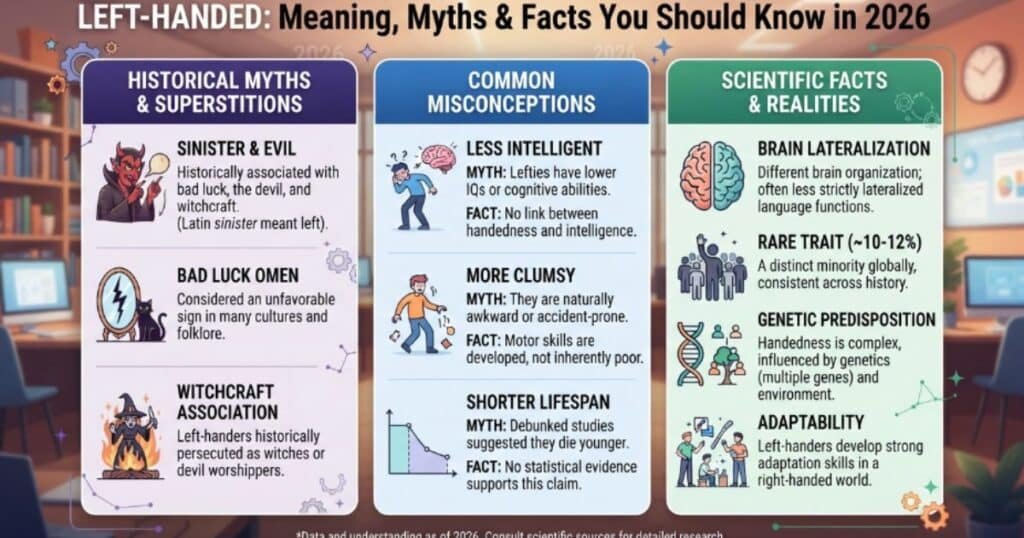

Left-handed meaning myths and facts have fascinated people for centuries. Some believe left handers are more creative while others think they are smarter or even unlucky. Many of these ideas are only myths. This guide explores Left-handed meaning myths and facts using simple language and real research. You’ll also learn how many people are left handed and why this unique trait has attracted so much attention throughout history.
If you’ve ever wondered what percentage of people are left handed, you’re not alone. Scientists estimate that about 10–12% of people prefer their left hand. That means the percentage of left handed people is much smaller than right-handed people. Knowing what percent of people are left handed helps explain why many everyday tools are designed for right-handed users.
In this article, you’ll discover the truth behind Left-handed meaning. We’ll separate myths from science with easy examples and interesting facts. Whether you’re a left-handed person or simply curious about Left-handed meaning myths and facts, you’ll find clear answers that make this fascinating topic easy to understand.
Being left handed – the myths and the facts

Many people have strong opinions about left-handedness. Some believe left-handed people are born with special talents while others think they face more health problems. The truth sits somewhere in the middle. Science supports some ideas, yet it completely disproves others. That’s why it’s important to separate facts from fiction.
If you live in a right-handed world, you probably notice small challenges every day. You may use a computer mouse with your right hand, shake hands with your right hand, or adjust to tools designed for right handers. Over time, many left handers become highly adaptable because they learn to work around these everyday obstacles.
Let’s explore the most common myths and facts about being left handed. You’ll discover what research says, what history reveals, and which popular beliefs simply don’t stand up to scientific evidence.
Fact – left handed people are rare
Yes, this one is true. Left-handed people make up only about 10–12% of the world’s population. That means roughly one in every ten people prefers using their left hand for writing, eating, and other daily tasks. Because the percentage of left handed people is so small, left-handedness remains a relatively rare human trait.
Scientists have studied hand dominance for decades. Although researchers still don’t know every reason behind it, they believe genetics, brain development, and environmental factors all play a role. Most people naturally become right handed while a much smaller group develops left-hand dominance. A few people even become ambidextrous, meaning they can comfortably use both hands.
Living as a leftie often means adapting to products and spaces designed for right-handed users. From classroom desks to kitchen tools, everyday life sometimes requires creative solutions. Even so, being left handed is simply a normal variation of human behavior rather than a disadvantage.
Myth – left handers are not more intelligent
This myth has circulated for years. Some people claim left handers have higher IQs or extraordinary creativity. Others believe the opposite. Neither claim tells the whole story.
Modern research has found no consistent scientific evidence proving that left-handed people are smarter than right-handed people. Intelligence depends on many factors including education, environment, genetics, and life experiences. Your dominant hand doesn’t determine how intelligent you are.
You may have heard that famous figures like Leonardo da Vinci, Albert Einstein, Charles Darwin, or Isaac Newton were left handed. While several historical figures were linked to left-handedness, historians still debate some of these claims. For example, evidence suggests Leonardo da Vinci may have been ambidextrous rather than exclusively left handed.
What left-handed people often develop is adaptability. Growing up in a right-handed world encourages many lefties to solve problems differently and adjust to equipment built for someone else. That doesn’t automatically make them more intelligent. It simply highlights their ability to adapt.
Fact – being left handed has been stigmatised heavily through the ages
History hasn’t always been kind to left-handed people. In many cultures, people viewed left-handedness with suspicion or treated it as something that needed correction. Children were often forced to write with their right hand even when using their left hand felt natural.
Language also reflects this historical bias. The Latin word sinistre eventually became associated with something evil or unlucky. In Old English, the word lyft carried meanings linked to weakness. Similar ideas appear in several European languages, where words connected to the left side often suggest clumsiness or awkwardness.
Cultural traditions also shaped these attitudes. In some parts of the Far East, especially in China and Japan, students traditionally practiced Chinese calligraphy or Japanese calligraphy with real ink. Left-handed writing often caused ink smudging because the hand moved across fresh writing. As a result, many children learned to write with their right hand instead.
Thankfully, attitudes have changed. Today, people recognize that left-handedness is a natural example of human diversity rather than a flaw. Greater awareness has improved accessibility, education, and acceptance around the world.
Myth – castle spiral staircases were advantageous to left handed swordsmen
This story sounds convincing, yet history doesn’t fully support it.
Many medieval castles featured spiral staircases that turned in a specific direction. Their main purpose was to help a right-handed defender fighting from above. The narrow steps limited an attacker’s movement while giving defenders more room to swing a sword.
A left-handed attacker didn’t automatically gain an advantage. In fact, the staircase design often made climbing even more difficult regardless of which hand held the weapon. On an open battlefield, a southpaw might surprise an opponent because of different fighting angles. Inside a castle, however, the design usually favored the defenders instead.
So while left handed swordsmen sometimes enjoyed unique advantages during combat, the famous staircase story remains more legend than proven fact.
Fact – half of cats are left handed
This fun fact has some truth behind it. Researchers studying animal laterality discovered that many cats show a clear paw preference. Some prefer their left paw while others favor their right. A smaller group uses both equally.
That doesn’t mean exactly half of all cats are left-pawed. Instead, studies suggest paw preference appears naturally among cats much like hand preference appears in humans. Scientists continue exploring why these patterns develop and how they relate to brain function.
Whether your cat is left-pawed or right-pawed, it’s another reminder that laterality exists across the animal kingdom.
Myth – left handers die younger and have more health issues
This myth has worried people for decades. Fortunately, modern research doesn’t support it.
Older studies suggested left handers had shorter lifespans. Later researchers discovered that the data included a major flaw. Many older adults had been encouraged or forced to switch to their right hand during childhood. That made the statistics unreliable.
Current scientific evidence shows no convincing proof that left-handed people naturally have shorter lives because of their handedness. Researchers have identified some minor neurological differences and brain differences, yet these variations don’t automatically lead to poor health or early death.
Like everyone else, left-handed people can enjoy long, healthy lives by maintaining healthy habits and receiving proper medical care.
Fact – a lot of our current leaders are / have been left handed
Several well-known leaders have been left handed. In the United States, former presidents such as George H. W. Bush, Bill Clinton, and Barack Obama all wrote with their left hand. The United Kingdom has also had notable left-handed members of the royal family, including Prince William and the Queen Mother.
These examples are interesting, yet they don’t prove that left-handed people make better leaders. Leadership depends on personality, experience, communication skills, and decision-making rather than hand preference.
Still, it’s encouraging to see successful political leaders from different backgrounds. Their achievements remind us that left-handedness doesn’t limit success.
Fact – there are lots of myths
Perhaps the biggest fact of all is that misinformation spreads quickly. Stories about intelligence, creativity, sports ability, health, and personality often travel much faster than scientific evidence.
When you read claims about Left-handed meaning myths and facts, always check whether reliable research supports them. A catchy headline doesn’t always tell the truth.
Being left handed simply means your left hand is your dominant hand. It doesn’t define your intelligence, creativity, personality, or future. Every person is different. That’s what makes human diversity so fascinating.
Left handed scissors
Most scissors are designed for right-handed users. Left-handed scissors reverse the blade position so you can see the cutting line clearly and enjoy a more comfortable grip. They reduce hand strain and improve cutting accuracy for school, crafts, sewing, and everyday tasks.
Left handed can opener
A standard can opener often feels awkward for lefties. A left-handed can opener places the turning mechanism in a more natural position. This simple design improves comfort and gives you better control while opening cans.
Left handed pencil
Many schools now offer left-handed pencils that encourage a comfortable pencil grip. These pencils can help children develop neat handwriting while reducing smudging and hand fatigue during long writing sessions.
Left handed pen
Specially designed left-handed pens use quick-drying ink and ergonomic shapes to reduce smearing. Some also improve writing posture by encouraging a relaxed grip. Many left-handed writers also tilt the paper slightly, which makes writing smoother and more comfortable.
Left-handed meaning, myths, and facts
The meaning of being left handed is simple. It means your dominant hand is your left hand. You naturally use it for writing, eating, throwing, and many daily tasks. Although this trait seems unusual because most people are right handed, it is completely normal.
Many stories surround Left-handed meaning myths and facts. Some claim left-handed people are born more creative while others say they struggle more in life. Modern handedness research tells a different story. Left-handedness is simply one form of human behavior and laterality. It reflects how the brain develops rather than how capable someone becomes.
Scary facts about left-handers
You may have seen shocking headlines about left-handed people online. Many of them exaggerate the truth to attract clicks. In reality, there are very few genuinely “scary” facts about left handers.
Here are the real facts:
- Left-handed people make up only about 10–12% of the world’s population.
- They often adapt to a right-handed world every day.
- Some older studies linked left-handedness to health problems. Newer research has challenged those conclusions.
- Scientists continue studying brain differences and cerebral dominance, yet no evidence proves left-handedness is dangerous.
The biggest scary fact isn’t about left handers. It’s how quickly misinformation spreads online.
Left-handed myths
Many myths have survived for centuries. Science has disproved most of them.
Some common myths include:
- Left-handed people are always smarter.
- Lefties are naturally more creative.
- They die younger.
- They have more health problems.
- They always perform better in sports.
- Left-handedness brings bad luck.
Research shows that individual differences, education, personality, and environment shape people far more than the hand they prefer.
Left-handed personality characteristics
People often ask whether left-handed people share certain personality traits. Researchers haven’t found one universal personality type.
However, many lefties describe themselves as:
- Adaptable
- Flexible
- Creative problem solvers
- Independent thinkers
These qualities may develop because they regularly adjust to tools and environments designed for right handers. That doesn’t mean every left-handed person has the same personality.
Left hand superstition itchy
In many cultures, an itchy left hand carries symbolic meaning. Some traditions say it means money will leave your pocket. Others believe it signals good luck, bad luck, or an important change.
These ideas come from folklore rather than science. There is no medical or scientific evidence linking an itchy left hand to future events. In most cases, dry skin, allergies, or irritation explain the feeling much better.
Left handed facts reddit
Reddit discussions about left-handedness can be entertaining because thousands of users share personal experiences. You’ll find stories about awkward school desks, computer mice, notebooks, sports, and funny everyday moments.
Still, remember that Reddit is not a scientific source. Personal experiences can be useful, yet they don’t replace peer-reviewed research or verified evidence.
Left hand history facts
The history of left-handedness is full of surprising twists.
Throughout history:
- Many children experienced forced right-handedness.
- Schools often discouraged writing with the left hand.
- Some societies connected left-handedness with superstitions.
- Language itself developed negative meanings for the left side.
- Modern education now accepts left-handedness as a natural human variation.
Thankfully, today’s society values inclusivity and recognizes that handedness doesn’t determine ability.
Facts about left-handed people
Here are several interesting facts backed by research:
- Around 10–12% of people are left handed.
- Left-handedness appears in every country and culture.
- Men are slightly more likely to be left handed than women.
- Some people become ambidextrous, although this is uncommon.
- Left-handed children often learn creative ways to adapt.
- Many famous artists, athletes, and political leaders have been left handed.
- Most everyday products still favor right-handed users.
Left handed meaning in Urdu
The phrase left handed translates into Urdu as:
بائیں ہاتھ والا (Baen haath wala)
or
بائیں ہاتھ سے کام کرنے والا (Baen haath se kaam karne wala)
It describes a person who naturally uses the left hand more than the right hand for writing and everyday activities.
Myths of left handedness
Several myths continue to circulate despite decades of scientific research.
For example, people still claim left-handed people have unusual intelligence, special creativity, or shorter lives. Others believe they are naturally better leaders or athletes.
Current research doesn’t support these sweeping claims. Hand preference is simply one characteristic among many that make each person unique.
Left hand argument
The phrase left hand argument can have different meanings depending on the context.
In everyday conversation, people sometimes use it to describe an unusual or alternative viewpoint. Historically, the phrase has also appeared in philosophy, religion, and literature with different symbolic meanings.
It doesn’t have one universal definition, so understanding the context is important.
Why were left-handed people considered witches
During the Middle Ages, fear and superstition shaped many beliefs.
Because the Latin word sinistre later became associated with evil, some communities wrongly viewed left-handed people with suspicion. Religious misunderstandings, folklore, and cultural traditions strengthened these ideas over time.
There was never factual evidence connecting left-handedness with witchcraft. These beliefs reflected fear and misunderstanding rather than reality.
Left handed meaning myths and facts psychology
Psychologists study hand preference, laterality, motor skills, and brain development to understand why people become left handed.
Research suggests that genetics and early brain development both influence handedness. Scientists continue exploring neuroscience, cognitive abilities, and manual dexterity, yet no psychological evidence suggests left-handed people are naturally superior or inferior.
Left handed meaning myths and facts reddit
Reddit communities often discuss everything from left-handed school experiences to favorite products and unusual habits. These conversations help people share experiences and practical advice.
However, always separate opinions from facts. Scientific studies remain the best source for understanding Left-handed meaning myths and facts.
Left handed meaning myths and facts bible
The Bible mentions both the left and right hand in different passages. It also refers to several left-handed individuals, including Ehud in the Book of Judges.
However, the Bible does not teach that left-handed people are cursed, evil, or less valuable than others. Many negative beliefs developed later through cultural traditions rather than biblical teaching.
25 weird facts about left handed people
Here are 25 fun facts:
- Only about 10–12% of people are left handed.
- Left-handedness appears worldwide.
- Cats can show left-paw preference.
- Some parrots favor one foot.
- Lefties often adapt quickly.
- Many desks favor right handers.
- Spiral notebooks can feel uncomfortable.
- Scissors work differently.
- Fountain pens may smudge.
- Computer mice are usually right handed.
- Some guitars require special designs.
- Sports opponents may face unfamiliar angles.
- Lefties appear in every profession.
- Some famous presidents were left handed.
- Prince William is left handed.
- Barack Obama writes with his left hand.
- Bill Clinton is left handed.
- George H. W. Bush was left handed.
- Hand preference develops early.
- Some children switch hands naturally.
- True ambidexterity is rare.
- Language once treated left-handedness unfairly.
- Modern schools encourage acceptance.
- Special left-handed products are widely available.
- Being left handed is a normal part of human diversity.
Left-handed facts
The strongest fact about left-handedness is also the simplest. It is a natural variation of human biology. It doesn’t determine intelligence, success, personality, or health.
Whether you’re a proud leftie, a curious parent, or someone researching Left-handed meaning myths and facts, remember this: your dominant hand is just one part of who you are. Your skills, character, and choices matter far more than whether you write with your left or right hand.
FAQ’s
Are left-handed people born that way?
Yes. Research suggests genetics and brain development influence handedness. Left-handed meaning myths facts show it is a natural human trait.
Is being left handed rare?
Yes. Around 10–12% of people are left handed worldwide. Left-handed meaning myths and facts confirm this makes lefties a minority.
Are left-handed people more creative?
Some lefties are creative, but science doesn’t prove all are. Left-handed meaning myths and facts separate popular beliefs from research.
Do left-handed people face everyday challenges?
Yes. Many tools and products suit right handers. Left-handed meaning myths and facts explain how lefties adapt with surprising ease.
Does being left handed affect health?
No strong evidence says left-handed people are less healthy. Left-handed myths and facts debunk many common health myths.
Why do so many myths exist about left handers?
History, culture, and superstition created many false beliefs. Left-handed myths and facts help replace misinformation with scientific evidence.
Can left-handed people be just as successful as right handers?
Absolutely. Success depends on skill and effort. Left-handed meaning myths and facts show handedness doesn’t limit achievement or leadership.
Conclusion
In the end, Left-handed meaning myths and facts remind us that being left handed is simply a natural part of human diversity. Many old beliefs have been disproved by science. Learning the truth helps you separate facts from fiction. If you have ever wondered how many people are left handed, the answer is about 10–12% of the world’s population. That makes left handers a unique but normal minority.
You may also ask what percentage of people are left handed or what percent of people are left handed. The answer stays almost the same across most studies. The percentage of left handed people has remained steady for many years. Left-handed meaning myths and facts show that handedness does not decide intelligence, creativity, health, or success.
Hopefully, this guide has answered your questions about Left-handed meaning myths and facts in a simple way. Whether you’re a leftie or just curious, the facts matter more than old myths. Celebrate what makes people different and remember that every person has unique strengths regardless of which hand they use.