
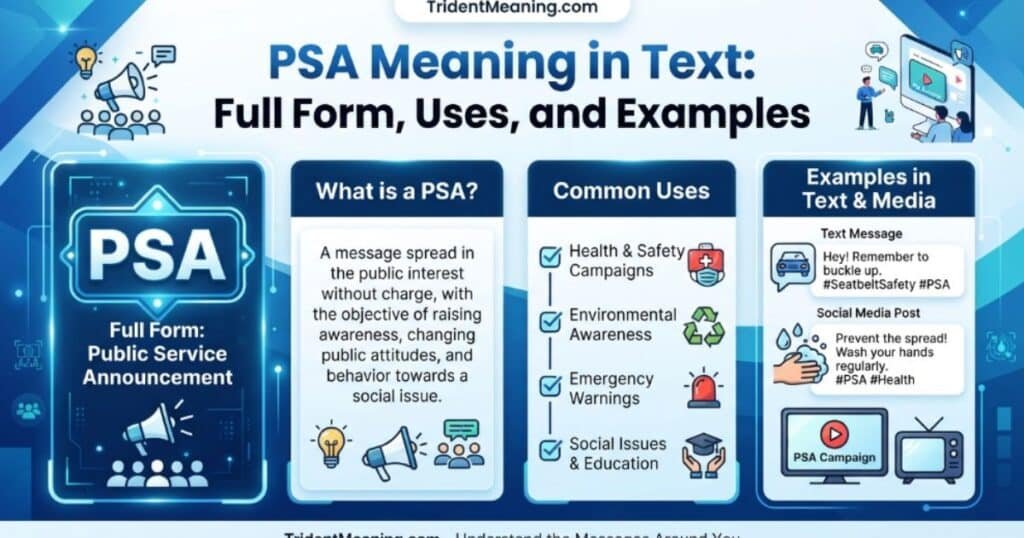

If you’ve seen “PSA” in a text or social media post, you may wonder what it means. The most common PSA meaning in text is “Public Service Announcement.” People use it to share important information, advice, warnings, or reminders. It can sound serious, funny, or even sarcastic depending on the message.
Understanding the PSA meaning slang can help you read texts and social media posts more clearly. Online, someone might write “PSA:” before sharing a quick tip, calling something out, or making a dramatic point. The phrase often grabs attention before the main message.
In this guide, you’ll learn the PSA slang meaning, how people use it in texting and chat, and what it means on popular social platforms. You’ll also see simple examples, common tones, and ways to reply when someone sends a PSA.
PSA Meaning and Full Form
PSA stands for Public Service Announcement. It is traditionally used for messages that share important information with the public, such as safety warnings, health advice, or helpful reminders.
In texting and social media, the PSA meaning in text is usually more casual. People often put “PSA:” at the beginning of a message to get attention before sharing something they think others should know. For example, “PSA: Don’t forget to bring your charger.”
The PSA meaning slang can also be humorous or sarcastic. Someone might use it for a simple reminder or a playful opinion, even when the information is not truly a public announcement.
What Does PSA Mean in Chat?
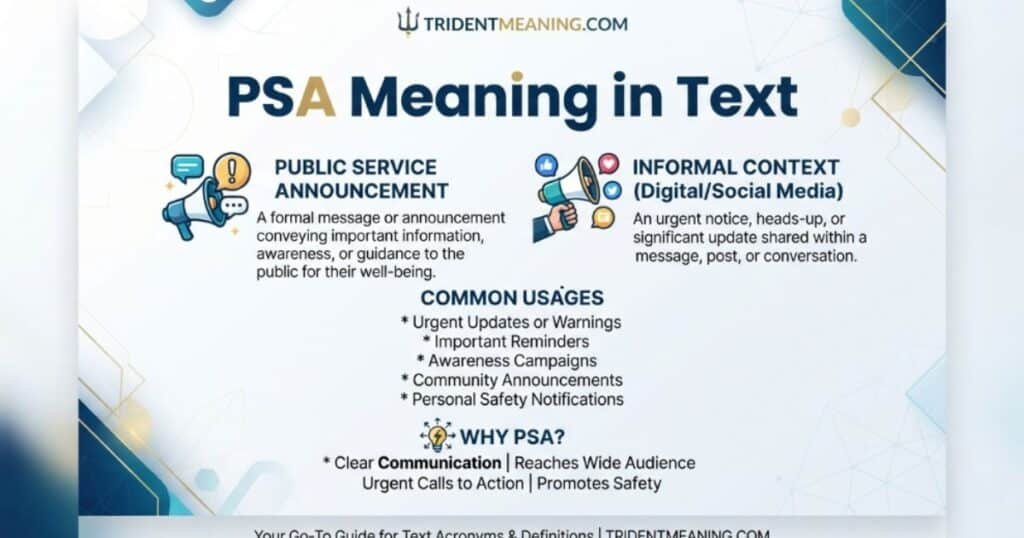
In chat, PSA usually means that someone is about to announce something important, useful, or worth noticing. The message can be serious, friendly, funny, or slightly dramatic depending on the context.
For example, a friend might text, “PSA: There’s leftover pizza in the fridge.” This is not a formal announcement, but the person uses PSA to make the information stand out.
When you see PSA in a conversation, focus on the message that follows it. That context usually tells you whether the person is giving advice, sharing a warning, making a joke, or simply reminding everyone about something.
Is PSA an Acronym or Slang?
PSA is an acronym for “Public Service Announcement.” Its original meaning comes from public information messages shared through traditional media such as television and radio.
Today, PSA can also have a slang-like use in casual online conversations. People use it as a quick attention-grabbing label before advice, reminders, jokes, or opinions.
So, the PSA slang meaning does not replace its original definition. Instead, online communication has given the acronym a more relaxed and playful use.
What Does PSA Mean on Different Platforms?
The PSA meaning in text stays the same across most platforms, but people may use it differently depending on the type of conversation. On social media, PSA often introduces advice, opinions, or humorous statements. In private messaging apps, it is more likely to introduce a reminder, warning, or useful update.
PSA Meaning on Snapchat
On Snapchat, PSA is often used in Stories, group chats, or text placed over photos and videos. It can introduce a quick reminder, opinion, warning, or playful announcement.
For example: “PSA: Stop texting your ex.” Here, PSA makes the advice sound more attention-grabbing and slightly dramatic.
PSA Meaning on TikTok
On TikTok, PSA commonly appears in captions, videos, and on-screen text. Creators may use it before sharing advice, opinions, warnings, or commentary about everyday situations.
For example: “PSA: Your situationship is not your soulmate.” The acronym helps frame the statement like an important announcement while keeping the tone casual.
PSA Meaning on Instagram
On Instagram, you may see PSA in Stories, Reels, captions, and carousel posts. It can introduce helpful information, personal advice, or a strong opinion.
For example: “PSA: Drink water, protect your peace, and mind your business.” The format makes the message feel direct and attention-grabbing.
PSA Meaning on WhatsApp
On WhatsApp, PSA is often more practical. People may use it in family groups, work chats, or friend groups to share reminders, event details, or important updates.
For example: “PSA: The meeting has been moved to 3 PM.” In this context, the phrase simply signals that the information is worth noticing.
PSA Meaning in SMS and Text Messages
In regular SMS and text messages, PSA usually introduces information that the sender wants you to notice. It can be a warning, reminder, update, or useful piece of advice.
For example: “PSA: The store closes early today.” The sender is not making a formal announcement. They are simply using the acronym to highlight the message.
PSA Tone and Context
The PSA slang meaning can change slightly based on the tone and situation. The same acronym may sound serious in one message and completely playful in another. Look at the words that follow “PSA” to understand the intended meaning.
Serious and Informative Meaning
A serious PSA shares information that may genuinely help someone or prevent a problem. It can cover safety warnings, important reminders, health information, or practical updates.
For example: “PSA: Check the weather before driving tonight.” The purpose is simply to make people aware of something important.
Funny and Playful Meaning
People also use PSA for jokes and lighthearted reminders. In these cases, the announcement is usually exaggerated for fun rather than because the information is truly important.
For example: “PSA: Self-control has officially left the chat.” The dramatic wording makes an ordinary situation more entertaining.
Sarcastic Meaning
A sarcastic PSA presents an opinion or criticism as if it were an official public announcement. The humor comes from treating an everyday situation as something extremely important.
For example: “PSA: They are all different until they are not.” The message may comment sarcastically on a common experience.
Romantic or Relationship-Related Meaning
In relationship conversations, PSA can introduce dating advice, emotional observations, or playful comments about relationships. The tone may be sweet, serious, or teasing.
For example: “PSA: If someone likes you, they make time for you.” Here, PSA gives the statement the feel of a general piece of relationship advice.
Angry or Critical Meaning
Someone may use PSA when calling out behavior they dislike or making a strong point. The acronym can make criticism sound more direct and attention-grabbing.
For example: “PSA: Respect people’s time.” The message is firm, but PSA itself is not rude. The surrounding words determine how critical the statement feels.
PSA Texting Examples
Examples in Everyday Conversations
People often use PSA in everyday chats to make a simple message stand out. It can introduce a reminder, useful tip, or casual announcement.
- “PSA: Bring a jacket tonight.”
- “PSA: There’s still pizza in the fridge.”
- “PSA: The deadline is tomorrow.”
- “PSA: Double-check your wallet before leaving.”
Examples of Funny PSA Messages
A funny PSA uses dramatic language for an ordinary situation. This makes the message playful and gives it an exaggerated sense of importance.
- “PSA: Self-control has left the chat.”
- “PSA: It is officially too late to start that diet today.”
- “PSA: Going to bed early is actually possible.”
- “PSA: Monday is coming whether you are ready or not.”
Examples of PSA in Relationship Chats
In relationship chats, PSA can introduce dating advice, emotional observations, or playful comments about someone’s romantic situation.
- “PSA: If they wanted to, they would make time.”
- “PSA: Stop texting your ex.”
- “PSA: Overthinking every reply is not helping.”
- “PSA: Your peace is worth more than a confusing relationship.”
Examples of PSA for Warnings and Reminders
A PSA can make warnings and reminders easier to notice. In these cases, the tone is usually direct and practical.
- “PSA: The store closes early today.”
- “PSA: Check the weather before heading out.”
- “PSA: The meeting starts at 3 PM.”
- “PSA: Don’t forget to charge your phone.”
How to Reply When Someone Says PSA
Your reply depends on what the person is announcing and the tone they use. A serious message deserves a straightforward response, while a joke can invite a playful reply.
Funny Replies to PSA
If the message is clearly joking or dramatic, you can match that energy with a humorous response.
- “Thank you for your service.”
- “Breaking news indeed.”
- “Noted with dramatic effect.”
- “This announcement has been received.”
Serious and Polite Replies
When PSA introduces genuinely useful information, keep your response simple and appreciative.
- “Thanks for the heads-up.”
- “I appreciate the reminder.”
- “Good to know.”
- “Thanks for letting me know.”
Casual or Neutral Replies
For an ordinary conversation, you do not need an elaborate response. A short acknowledgment is usually enough.
- “Got it.”
- “Okay.”
- “Makes sense.”
- “Good call.”
Flirty Replies
If someone you like sends a playful PSA, you can respond with a light, flirty comment that matches the conversation.
- “Only listening because it’s you.”
- “You always have the best announcements.”
- “Another PSA from my favorite person?”
- “I’m paying attention now.”
Is PSA Rude or Appropriate to Use?
PSA meaning in text itself is not rude or offensive. The meaning and tone depend on the message that comes after it. You can use it casually, seriously, or humorously in the right setting.
Is PSA Considered Rude or Disrespectful?
No, PSA is not inherently rude or disrespectful. However, a harsh or insulting message can make the overall statement sound critical.
For example, “PSA: Respect people’s time” may sound firm, but the acronym itself is harmless. Context determines how the message is received.
Can You Use PSA at School or Work?
Yes. PSA can work in school messages, group projects, workplace chats, and internal updates when you want to highlight useful information.
For professional communication, keep the wording clear and avoid sarcasm if the message could be misunderstood. A simple reminder such as “PSA: The report is due Friday” is appropriate.
When Should You Avoid Using PSA?
Avoid PSA when the situation is highly sensitive or when a dramatic or sarcastic tone could cause confusion. It is also better not to use it for every small message.
If the information needs a very formal tone, a direct announcement or reminder may be clearer than using casual texting slang.
PSA in Formal and Informal Communication
The PSA meaning in text has expanded beyond traditional public announcements. Today, the acronym can appear in both formal informational settings and casual online conversations, although the tone differs.
PSA in Public Announcements
The original use of PSA refers to a Public Service Announcement designed to inform the public. Traditional PSAs often appeared on television or radio and covered topics such as safety, health, and public awareness.
In this setting, PSA has a literal and formal meaning rather than a slang meaning.
PSA in Workplace Communication
At work, PSA can introduce an important update, reminder, or piece of information for a team. It is especially useful in internal chats where communication is relatively informal.
For example: “PSA: The meeting room has changed to Conference Room B.”
Keep workplace PSAs professional and straightforward, particularly when communicating with managers, clients, or larger groups.
PSA in Casual Online Conversations
Online, PSA is much more flexible. People use it in texts, social media posts, captions, and group chats to introduce advice, opinions, warnings, jokes, or dramatic observations.
This casual use is why the PSA slang meaning can feel different from its traditional definition. The basic idea remains the same: the writer wants you to pay attention to what comes next.
Where Did PSA Come From?
PSA did not begin as internet slang. Its modern online use comes from the established phrase Public Service Announcement, which has been used to share information with the public.
The Original Meaning of Public Service Announcement
A Public Service Announcement is a message created to inform people about an issue that may affect the public. Traditional examples include safety warnings, health campaigns, and government information.
These announcements were commonly delivered through broadcast media such as television and radio. Their goal was to make important information easy for the public to notice.
How PSA Became Internet Slang
As online communication developed, people began using PSA in a more relaxed way. Social media users adopted the acronym to introduce advice, reminders, opinions, and humorous observations.
Internet humor also changed the tone. A person could write “PSA:” before an ordinary or exaggerated statement and make it sound like an official announcement.
Short-form platforms such as TikTok further encouraged this attention-grabbing style. Today, PSA can be both informative and playful depending on the context.
PSA vs Similar Texting Terms
PSA can sometimes seem similar to other expressions that introduce information. However, each term has a slightly different purpose.
| Term | Main Purpose | Typical Tone |
| PSA | Highlights information, advice, warnings, or announcements | Informative, dramatic, or playful |
| FYI | Provides information someone may want to know | Neutral and practical |
| Announcement | Officially shares information with a group | Formal or direct |
| Reminder | Helps someone remember something | Practical and straightforward |
PSA vs FYI
PSA and FYI can both introduce useful information, but they have different feels. FYI means “for your information” and usually provides information without making it sound like an announcement.
PSA often gives the message more emphasis and can carry a humorous or dramatic tone.
PSA vs Announcement
An announcement is a general term for information being formally or publicly shared. PSA specifically comes from “Public Service Announcement.”
In casual texting, people may use PSA as a playful way to frame an announcement, even when the message is not official.
PSA vs Reminder
A reminder helps someone remember something they already need to know. PSA can introduce a reminder, but it can also introduce advice, warnings, jokes, or opinions.
For example, “Reminder: Bring your charger” is direct, while “PSA: Bring your charger” gives the message more attention.
Common Mistakes When Using PSA
Although PSA is easy to use, context still matters. Using it thoughtfully helps your message sound natural rather than forced.
Using PSA Without Useful Information
A PSA meaning in text should introduce something worth noticing. If the message contains no useful information, advice, warning, or clear point, the acronym can feel unnecessary.
Before using PSA, ask whether the following message gives the reader something meaningful to notice.
Overusing PSA in Conversations
Using PSA repeatedly can make the expression lose its impact. Not every text needs to sound like a public announcement.
Save it for moments when you genuinely want to highlight advice, a reminder, warning, update, or humorous point.
Misunderstanding the Tone
The biggest mistake is assuming every PSA is serious. Online, people often use it sarcastically, playfully, or dramatically.
Always consider the surrounding words and the relationship between the people chatting. That context will help you understand the intended PSA slang meaning and respond appropriately.
FAQs
What does PSA mean in text messages?
PSA meaning in text usually refers to Public Service Announcement, introducing advice, warnings, reminders, or useful information.
What does PSA mean on social media?
On social media, PSA meaning in text often introduces an attention-grabbing tip, opinion, warning, or humorous statement.
Is PSA considered rude in texting?
No, PSA is not rude by itself. The tone depends on the message and the surrounding context.
How should you respond to a PSA?
You can respond seriously with thanks, casually with got it, or humorously when the original message is playful.
Can you use PSA at work?
Yes, PSA meaning in text can introduce workplace reminders or updates, but avoid sarcasm when communicating professionally.
Is PSA an acronym or slang term?
PSA is an acronym for Public Service Announcement. Online users also use it casually for advice, jokes, and reminders.
When should you avoid using PSA?
Avoid it in sensitive situations or when sarcasm could cause confusion. A direct message may work better for formal communication.
Conclusion
PSA meaning in text usually refers to Public Service Announcement. In everyday texting, people use it to introduce advice, reminders, warnings, updates, or opinions. The acronym can sound serious, helpful, funny, sarcastic, or dramatic depending on the message that follows. Context is the easiest way to understand the intended meaning.
You may see PSA on Snapchat, TikTok, Instagram, WhatsApp, or in regular text messages. Its original meaning relates to public information shared through traditional media, while online users have made the expression more casual and playful. You can also use it at school or work for clear updates, as long as the tone fits the situation.
The key takeaway is simple: PSA signals that something deserves attention. If the message is useful, timely, or entertaining, the abbreviation can make your point stand out without sounding complicated or forced.