

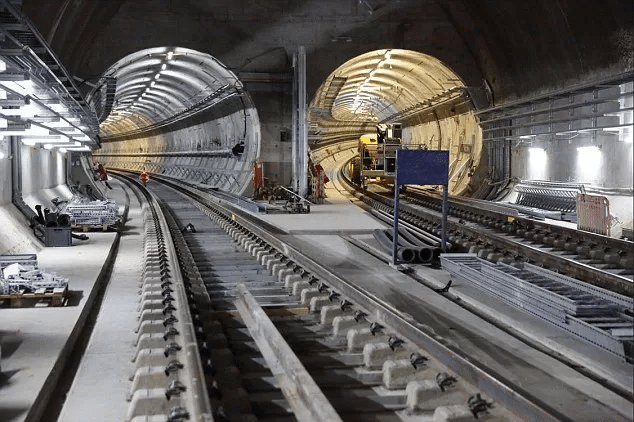
When someone hears the word railway, it is normal that many of us think about rail-tracks, tunnels and rail-platforms. And all of these require a complex network of systems which cover important functions behind the scene such as signaling, communication, power distribution, fire-protection and passenger safety. To make installation or upgrade for such services always involves creation of precise holes in concrete structures.
Drilling for cable isolation and other services are important aspects for the railway construction and its improvement. This type of work requires planning by keeping the existing structure, type of services and requirements of the whole process.
Why rail requires specialized drilling
The railway construction site is not the same as any building site. Construction could take place in tunnels, in stations, on platforms or around existing reinforced concrete structures.
Holes might be required for:
- Cable containment and electrical installations
- Signaling and telecommunications installations
- Fire protection installations and related pipework
- Walkway and associated infrastructure
- Firestop service penetrations for mechanical and electrical services
Accurate MEP layout design determines the size and location of each structural opening. Improper positioning of holes complicates installation routing for subsequent trades. Inappropriate core drilling or cutting technology might lead to concrete structural damage or interfere with existing building services utilities.
Thus, drilling layouts have to be agreed upon the structural drawing and installation teams beforehand.
Working within existing resources
For core drilling preparation before the construction process, there is a need for audits of the structural plans and MEP plans, laying out each penetrations layout, and carrying out structural integrity tests if necessary. GPR scanning and subsurface utility locating will assist in detecting any embedded rebar and hidden conduits, and depending on the nature of the location, one will choose the most efficient test technique that is not destructive.
The drilling team needs exact dimensions including the diameter, depth, orientation, and spatial dimensions of each drilled hole to be drawn on the layout. The engineer will have to ensure that all these specifications are based on the mechanical and electrical design requirements rather than the limitations of the drilling equipment.
Discussions between the principal contractor, the structural team and the mechanical/electrical contractors at an early stage are helpful for minimizing conflicts and reworks.
Selecting the proper approach
This technique should match the type of material, the size of opening, access and surrounding construction.
For circular holes in concrete and reinforced concrete, diamond core drilling is typically used. This technique is suitable for service penetrations that require the diameter and precise positioning.
Sometimes other opening sizes and shapes make another cutting arrangement more appropriate.
Some other important issues require consideration:
- Access for equipment and operators
- Space for operations in relation to the hole
- Supply of water and slurry retrieval for wet drilling
- Dust control where dry techniques are proposed
- Safe core removal
- Protection of nearby equipment and installed equipment
Deciding on the technique early will allow the drilling to fit into the installation sequence and the overall programme.
Working safely on the railway
Special safety planning will be required in case the drilling is performed near railway track.
For this the project team should arrange the access, define the boundaries of the worksite, allowable time of works and any railway protection required. In case of working near the operational railway tracks, it is the procedure provided by railway and risk assessment carried out for this particular project that determines the technique of work.
It is also important to treat the existing underground services carefully. As mentioned above, the document HSG47: Avoiding Danger from Underground Services by Health and Safety Executive highlights the importance of careful planning of the work, location and identification of the services and following the safe system of work.
As this also creates concrete dust, water, slurry, and drilled core samples, all of these need to be managed properly. Effective management will surely ensure that the workers, the machineries, and the railroads are protected.
Crossrail: drilling for cable containment and essential services
The work done by CA Drillers at the Crossrail project between Plumstead and Paddington is a perfect example of specialized drilling in rail conditions.
From June 2016 onwards, the team began its work inside the tunnel, which had just been constructed. They started by carrying out cutting work in a cross passage and concrete repairs. Subsequently, the work scope was expanded to involve drilling of thousands of openings for cable containment, fire mains and the emergency walkway system.
This illustrates how drilling is part of a much larger infrastructure project. Openings for critical services need to be provided in conjunction with other construction works and cannot be performed on their own.
Refer to the Crossrail case study for more information about the project.
Things that project teams need to verify before drilling
Some of the things that project teams need to verify prior to commencing any specialized drilling work are as follows:
- Drawings and locations of all the openings
- Size and direction of the openings
- Reinforcement details and other existing embedded services
- Access of equipment and the work space required
- Railway access, work site protection and working arrangements
- Disposal of water, slurry, dust and concrete cores
Covering the above mentioned up-front helps the drilling support for the next stage of construction without avoidable delays.
Concluding remarks
Openings for cable ducts and other critical services form an integral part of many rail projects. The success of such tasks hinges upon proper setting-out, appropriate drilling techniques, and sufficient knowledge of the building concerned.
The experience of CA Drillers on the Crossrail project is an indicator of how big and coordinated such operations can be. Proper planning and control still play a key role in such cases.