
Ever seen “anon” pop up in a chat and wondered what it means? You’re not alone. The anon meaning is simpler than you think.
So, what does anon mean? It’s short for anonymous. It’s the most common anon meaning slang you’ll find online today. People use it everywhere: texts, social media, forums.
Curious about the anon meaning on dating apps? Wondering what does anon mean on dating sites? It simply means someone hiding their identity. The abbreviation for anonymous keeps things private. Think of “anon” as the everyday anonymous acronym people actually use.
Now you’ve got the basic anon meaning down. Let’s dig deeper into where it comes from and how to use it right.
Quick Answer
Spotted “anon” in a message and not sure what it means? Here’s the short version.
Anon meaning is almost always “anonymous.” It means someone is hiding their name or identity. You’ll see it everywhere: group chats, comment sections, Reddit threads, dating apps.
But here’s the twist. In older English, anon once meant “soon.” So context is everything.
Two meanings. One tiny word. Let’s break both down clearly.
Quick Reference Table
| Situation | Anon Meaning |
| “Posting anon for privacy” | Anonymous (no name) |
| “See you anon!” | Soon (old-fashioned) |
| “Got an anon message” | Anonymous sender |
| “Author: anon.” | Anonymous author |
| “Back anon busy rn” | Shortly / in a bit |
TL;DR
- Anon meaning = anonymous in almost every modern text
- It’s the everyday abbreviation for anonymous
- Rarely, anon means “soon” but that’s old-fashioned
- Context tells you which meaning fits instantly
- Use “anonymous” in formal or professional writing
What Does Anon Mean in Texts in 2026?
Texting has its own language. And anon meaning sits right at the center of it.
In 2026, anon almost always means “anonymous.” It points to a person with no name attached. Or a message sent without any identity behind it. People use it when privacy matters or when the sender is simply unknown.
Here’s what anon meaning in chat looks like in real life:
- “Can I ask you something anon?”
- “Someone slid into my DMs from an anon account.”
- “Posted anon so my coworkers don’t see it.”
- “The anon who said that was actually right.”
Don’t assume anon always means “soon.” That’s the most common mix-up. In texting, start with “anonymous” as your first guess you’ll be right nearly every time.
One more thing. Tone matters. Anon can feel neutral and private. But in heated conversations, it can come across as secretive or even suspicious. Keep that in mind before you use it.
Plain-English Meaning: Anon = Anonymous
Strip it all the way down. Anon means “no name.”
That’s really it. The person either isn’t known or chose not to share their identity. Nothing more complicated than that. Think of it as the shortcut everyone agreed to use without ever having a meeting about it.
Here’s how anon meaning in messages plays out day to day:
- “I got an anon DM about the party.”
- “Let’s keep this anon, please.”
- “She runs an anon account for her opinions.”
- “Anon tip try the new taco place downtown.”
One mistake people make? Mixing up “anon” with “private.” They don’t mean the same thing. A private account limits who can see your content. An anon account hides who you are. Big difference.
Also worth knowing if you’re using anon in an accusatory way, it can land pretty sharp. If the conversation is sensitive, neutral wording works better. Clarity always wins over cleverness.
How Anon Shows Up in Messages
Anon is a shapeshifter. It works as a label, a noun, and a casual adjective sometimes all in the same conversation.
You’ll spot it in three main patterns:
- Anon + noun → anon post, anon message, anon account
- An anon → referring to an anonymous person
- Posting anon → sharing something without a name
Real examples you’ll actually see:
- “This is an anon question, but is it normal to feel this way?”
- “He replied from an anon account sketchy.”
- “Please answer anon if you’re uncomfortable.”
- “Anon in the comments actually nailed it.”
Here’s a grammar tip most people miss. Write “an anon” not “a anon.” Because anon starts with a vowel sound, it takes “an.” Small thing but it matters.
And one more heads-up. The phrase “anon account” can raise eyebrows depending on the context. If trust is already shaky in a conversation, it’s worth adding a reason for staying anonymous. A little transparency goes a long way even when you’re being anon.
Anon vs Anonymous vs Anon.
Three forms. Same root. But they don’t all mean exactly the same thing in practice.
Knowing which one to use and when saves you from awkward misreads. Here’s the anon vs anonymous meaning broken down as simply as possible:
| Form | Style | Best Used In |
| anon | Informal, casual | Texts, chats, social media, forums |
| anonymous | Full word, formal | Emails, essays, professional writing |
| anon. | Abbreviation with period | Author credits, bibliographies, writing |
Quick examples side by side:
- “I asked anon.” → casual, texting
- “I asked anonymously.” → clearer, more formal
- “Author: anon.” → writing convention, not slang
- “The source remains anonymous.” → professional context
The period version anon. is a writing abbreviation. Don’t use it in a text like it’s slang. It’ll confuse people. And in school or work writing, skip “anon” altogether. “Anonymous” is always the safer, cleaner choice there.
Bottom line? Same idea, different registers. Match the word to the room you’re in.
The Older Meaning: Anon = Soon
Here’s something most people don’t know. Anon didn’t start as internet slang. It’s actually an old English word and it once meant “soon” or “shortly.”
You might still catch it today in playful or old-fashioned phrases:
- “See you anon.”
- “I’ll reply anon.”
- “Back anon busy day.”
It can work in modern texts too, but only in a lighthearted way:
- “BRB back anon.”
- “I’ll text you anon after dinner.”
- “Hold up, I’ll be there anon 😄”
Don’t use this meaning in serious planning conversations though. If you text your boss “I’ll send the report anon,” you’re asking for trouble. Just say “soon,” “in a bit,” or “later today.” Clear always beats clever.
Emojis are your best clue here. When someone uses anon with a winking face or laughing emoji, they almost certainly mean “soon” not anonymous. Keep that in mind.
How to Tell the Meaning Fast
Two meanings. One word. Sounds confusing but it really isn’t once you know what to look for.
You can figure out the anon meaning context in about three seconds. Just check these three things:
1. What’s the topic? Identity talk → anonymous. Time talk → soon.
2. Where does it sit in the sentence? Near words like “post,” “account,” or “message” → anonymous. Near words like “back,” “see you,” or “later” → soon.
3. What’s the tone? Serious and private → anonymous. Playful with an emoji → soon.
| Example | Anon Meaning |
| “Posting anon because my boss follows me.” | Anonymous |
| “See you anon!” | Soon |
| “An anon said the same thing.” | Anonymous person |
| “Author listed as anon.” | Anonymous author |
| “Back anon 😂” | Shortly / soon |
One golden rule never guess from the word alone. Read the five words around it. That tiny habit eliminates almost every mix-up instantly.
How to Use Anon to Mean Anonymous
This is the big one. The anon meaning in messages that dominates modern texting. And honestly? It’s easy to use once you see the patterns.
Here are the most natural sentence structures:
- “Can I ask anon? It’s personal.”
- “I got an anon tip about the meeting.”
- “I’m posting anon so nobody targets me.”
- “An anon in the thread actually explained it well.”
- “Stop sending anon messages, please.”
- “He’s hiding behind an anon account again.”
One mistake to avoid don’t use anon as a verb. Saying “I’ll anon you” makes no sense. Instead say “I’ll stay anonymous” or “I’ll post anonymously.” Keep it as a noun or adjective and you’re golden.
If you’re asking someone to reply anonymously, be polite about it too. Some people feel uneasy with hidden identity requests. A simple “feel free to answer anon if you’re uncomfortable” goes a long way. Respectful framing makes the whole thing land better.
When Not to Use Anon
Anon is casual. Really casual. And that’s exactly why it doesn’t belong everywhere.
Avoid anon in these situations:
- School essays and reports
- Job applications or resumes
- Emails to teachers or managers
- Customer service messages
- Legal or medical communication
In those settings, swap it out for something cleaner:
- “anonymous” clear in any setting
- “unnamed” works well in reports
- “unidentified” professional and precise
- “without a name attached” plain and direct
| Context | Best Choice | Why |
| Friend group chat | anon | Casual and instantly understood |
| Community safety post | anonymous | Clear and respectful tone |
| Email to a teacher | anonymous | Formal and unambiguous |
| Report or article | unnamed / unidentified | Standard reporting language |
| Bibliography or author note | anon. | Conventional writing abbreviation |
| Dating app conversation | anonymous | Clearer and less confusing |
The core idea is simple. In sensitive or professional settings, clarity builds trust. Slang can quietly chip away at that trust even when you don’t intend it to.
Spelling and Punctuation Tips
Small details. Big difference. Here’s how to write anon correctly every time.
The basic rules:
- anon → standard lowercase, everyday texting
- ANON → all caps, used for strong emphasis
- anons → plural, common in online communities
- anon. → period included, writing abbreviation only
Real examples in context:
- “Anon question is this even normal?”
- “ANON PLEASE.” (intense, can feel pushy use carefully)
- “The anons in that thread were genuinely helpful.”
- “Poem signed: anon.”
Two things to watch. First don’t add a period in casual texting. “anon.” in a DM reads like a writing credit, not slang. Second all caps reads as shouting. Use it only when you genuinely mean to emphasize something strongly.
Lowercase, no period. That’s your default. Stick with it and you’ll never look out of place.
Common Mistakes and Quick Corrections
People mix up anon more than you’d think. Here are the most common slip-ups and exactly how to fix them fast.
Confusing the two meanings Mixing up anonymous and soon happens constantly. Fix it by asking one quick question “does this sentence talk about identity or time?”
Mixing up anon with “secret” Anon hides an identity. Secret hides information. They’re not the same. Use the right word for what you actually mean.
Using anon in formal writing It’s slang. It doesn’t belong in professional emails, essays, or reports. “Anonymous” is always the safer call.
Making requests too vague “Tell me anon” leaves people guessing. Be specific “Feel free to answer without your name.”
Before-and-after rewrites:
| Before | After |
| “Tell me anon.” | “Tell me without your name.” |
| “See you anon” (work chat) | “See you soon.” |
| “Anon account messaged me” | “An anonymous account messaged me.” |
| “Anon.” (in a DM) | “Anonymous.” |
| “I’ll anon my reply.” | “I’ll reply anonymously.” |
Match the word to the setting. That single habit fixes nearly every anon mistake before it happens.
Alternatives and Related Terms
Sometimes anon just isn’t the right fit. Here are solid alternatives choose based on tone and context.
Formal replacements:
- anonymous full word, works anywhere
- anonymously adverb form (“she posted anonymously”)
- unnamed great for reports and articles
- unidentified professional and precise
- pseudonymous uses a made-up name, not a real one
Casual / internet alternatives:
- throwaway account temporary, often used for sensitive posts
- alt account secondary account, not the main profile
- burner account short-term, often for hiding identity
- no-name casual way to say unidentified
- private account restricted access, but not the same as unnamed
Quick examples:
- “I want to stay anonymous.”
- “She posted anonymously about her experience.”
- “An unidentified caller left a voicemail.”
- “That reply came from a throwaway account.”
One common mix-up “private” does not mean “anonymous.” Private limits who sees you. Anonymous hides who you are. Different tools. Different purposes.
Mini Quiz
Think you’ve got the anon meaning down? Let’s find out. Pick the best answer for each then check the key below.
Q1: “Posting anon because my family follows this account.” Q2: “See you anon stuck in traffic lol.” Q3: “I got an anon message about the event.” Q4: Rewrite this for a teacher: “Can I ask anon?” Q5: “Anon in the comments actually got it right.”
Answer Key:
| Question | Answer |
| Q1 | Anonymous hiding identity from family |
| Q2 | Soon time meaning, casual tone |
| Q3 | Anonymous unknown sender |
| Q4 | “May I ask anonymously?” or “May I ask without giving my name?” |
| Q5 | Anonymous person noun usage |
How’d you do? If you nailed all five, you’ve fully cracked the anon meaning puzzle. If one tripped you up go back and reread that section. It clicks fast on the second pass.
Where Did the Word Anon Come From?
The anon origin meaning goes back further than the internet. Way further.
Anon comes from Old English specifically from the phrase “on ane,” meaning “in one” or “at once.” It evolved over centuries into a word that meant “soon” or “shortly.” You’d find it in Shakespeare, the King James Bible, and classic English literature without blinking.
Then the internet happened.
Online communities especially anonymous forums started shortening “anonymous” to “anon” purely for convenience. It was faster to type. It stuck. And over time, the new meaning completely overtook the old one in everyday digital communication.
So the word pulled off a rare trick. It survived centuries as one thing and then quietly reinvented itself for a new era. Today, almost nobody uses anon to mean “soon” unless they’re being deliberately old-fashioned or playful.
Two meanings. Centuries apart. One tiny word.
Anon on Social Media: Reddit, 4chan, and Beyond
Want to understand anon meaning social media? Start with 4chan.
4chan is where the modern internet version of anon truly took root. The platform allows fully anonymous posting by default. Users started calling each other “anon” as a general term, part nickname, part inside joke. It spread fast. Reddit picked it up. Twitter followed. Eventually it filtered into everyday texting and group chats.
Here’s how anon shows up differently across platforms:
| Platform | How Anon Is Used |
| 4chan | Default identity for all unnamed posters |
| Throwaway or unnamed accounts posting sensitive topics | |
| Twitter / X | Anon accounts with hidden real identities |
| Dating apps | Users hiding their name or face temporarily |
| Group chats | Asking questions without revealing who’s asking |
| Anonymous Q&A tools and story reply features |
The anon meaning online shifted from a simple abbreviation into a full cultural concept. Being “anon” online means more than just hiding your name. It implies a certain freedom the ability to speak without social consequences.
That’s powerful. And sometimes problematic. Anonymity online can protect vulnerable people. It can also shield bad behavior. Understanding anon means understanding both sides of that coin.
Is Anon Slang or Standard English?
Honest answer? It’s both depending on where you use it.
As a shortening of “anonymous,” anon functions as informal standard English. It’s widely understood, consistently used, and even appears in some dictionaries. That gives it more legitimacy than pure made-up slang.
But here’s the line. In casual digital spaces texts, chats, forums, social media anon is completely natural. Nobody blinks. In formal writing though, it still reads as slang. Editors would flag it. Teachers would circle it. Spell-checkers often question it.
The anon meaning in modern English sits in an interesting middle ground:
| Context | Is Anon Acceptable? |
| Text messages | Yes totally natural |
| Social media posts | Yes widely understood |
| Online forums | Yes expected and normal |
| Casual emails | Usually fine |
| Academic essays | No use “anonymous” |
| Professional reports | No use “unnamed” or “anonymous” |
| Legal documents | Never use full formal terms |
So is it slang? Mostly yes, in the traditional sense. Is it understandable to nearly everyone online today? Absolutely yes. Anon slang meaning has become so mainstream that the line between slang and informal standard English is genuinely blurry now.
Use it where it fits. Ditch it where it doesn’t. That’s the whole game.
Can You Use Anon in Professional or Work Messages?
Short answer probably not. Here’s why.
Workplaces run on clarity. When you drop “anon” into a professional email or Slack message, it can read as careless. Or worse, unclear. Your manager might not even know what you mean. And that’s already a problem.
There’s also a trust issue. In professional settings, anonymity can raise eyebrows. If you’re flagging a concern or sharing feedback, “anon” sounds evasive. “Anonymous” sounds intentional and considered. Same idea completely different impression.
Here’s a quick guide:
| Situation | Use This Instead |
| Reporting a workplace issue | “I’d like to remain anonymous.” |
| Sending feedback to HR | “Submitted anonymously.” |
| Team Slack message | “Anonymous suggestion box” |
| Work email to a manager | “Without identifying myself” |
| Professional report | “Unnamed source” or “unidentified” |
One exception worth noting. Some companies use anonymous feedback tools like pulse surveys or suggestion platforms. In those specific contexts, “anon” might appear in the tool’s own interface. That’s the tool’s language, not yours. In your actual written communication, stick with “anonymous” every single time.
Professional writing rewards precision. Give it that.
What Does “Posting as Anon” Mean Online?
It means sharing something without attaching your real name or identity to it. Simple as that.
But the anon meaning online carries more weight than just hiding a username. When someone posts as anon, they’re making a deliberate choice. They want the message to exist but not the messenger. The idea stands alone. The person behind it disappears.
You’ll see it across every major platform:
- On Reddit, someone creates a throwaway account to share something personal or sensitive
- On Twitter/X, an anon account posts opinions their real profile never would
- On Instagram, anonymous Q&A stickers let followers ask things without showing their name
- On 4chan, every post is anon by default the whole platform runs on it
- On dating apps, some users blur photos or withhold names until they feel safe
There’s a real reason people post as anon. Sometimes it’s protection from judgment, from employers, from abusive people. Sometimes it’s freedom saying something honest without social consequences. And sometimes, honestly, it’s just easier.
Understanding anon’s meaning in digital communication means recognizing that anonymity isn’t always suspicious. Most of the time it’s just human. People want to speak. They don’t always want to be known.
How Did Anon Shift From Old English to Internet Slang?
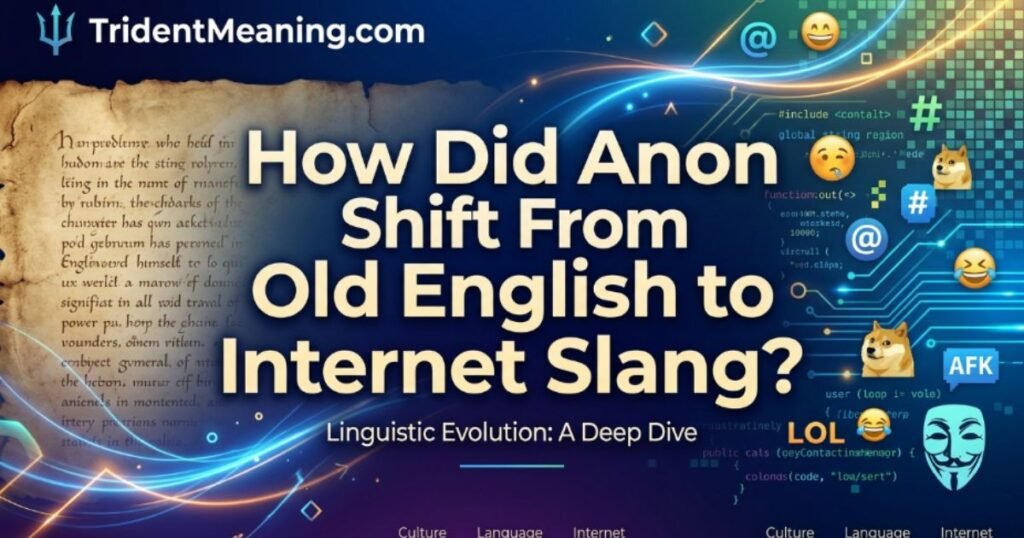
It’s one of the more fascinating word journeys in the English language. And it happened in two very distinct chapters.
Chapter one Old English. The word traces back to the Old English phrase “on ane” meaning “in one moment” or “at once.” For centuries it meant “soon” or “shortly.” Writers used it everywhere. Shakespeare used it. The King James Bible used it. It was elegant, common, and completely unremarkable for its time.
Then it faded. By the 20th century, “anon” felt archaic. Most people replaced it with “soon,” “shortly,” or “in a bit.” The word nearly disappeared from everyday speech entirely.
Chapter two the internet. This is where everything changed.
Anonymous online forums especially 4chan, launched in 2003 gave nameless users a new identity. They weren’t called “users” or “guests.” They were called anon. The abbreviation for anonymous got compressed into something punchy, communal, and instantly recognizable. It spread through forums, then Reddit, then Twitter, then into everyday group chats and text messages.
Here’s the full timeline at a glance:
| Era | Anon Meaning | Where It Appeared |
| Old English (pre-1600s) | “At once” / “soon” | Literature, scripture, speech |
| 17th–19th century | “Shortly” / “in a moment” | Poetry, plays, formal writing |
| Early 20th century | Fading from common use | Rare literary references |
| Early 2000s | Anonymous person online | 4chan, early forums |
| 2010s | Shortened form of anonymous | Reddit, Twitter, social media |
| 2020s–2026 | Mainstream internet slang | Texts, chats, dating apps, everywhere |
The shift wasn’t planned. Nobody decided anon would make a comeback with a brand new meaning. It just happened organically, digitally, unstoppably. That’s how living languages work. Words don’t retire. They reinvent themselves.
And anon? It reinvented itself beautifully.
FAQ’s
What Does Anon Mean in Text?
Anon meaning in text is almost always anonymous. It simply means someone is hiding their name or identity.
Is Anon Short for Anonymous?
Yes, anon is short for anonymous. That is the most common meaning used in modern texting and online chats.
Does Anon Ever Mean Soon?
Yes, meaning can also mean soon. But that usage sounds old-fashioned and rarely appears in everyday modern texts.
What Is the Difference Between Anon and Anonymous?
Anon meaning is the casual short form. Anonymous is the full word and always the safer choice in formal writing.
How Do You Use Anon in a Sentence?
Anon meaning shows up like this posting anon for privacy or an anon messaged me. Simple and natural.
Is Anon Formal?
No, meaning informal slang. Always use anonymous in professional emails, school essays, or any serious written communication.
What Does Anon Mean on Dating Sites?
Anon meaning on dating sites refers to hiding your real identity. Users stay anon until they feel safe enough to share.
What Is the Anon Abbreviation Meaning?
The anon abbreviation meaning comes from anonymous. It is the shortened internet version people use daily across texts and social platforms.
Can Anon Be Used as a Noun?
Yes, meaning works as a noun too. Saying an anon replied or the anon was right are both completely natural uses.
Conclusion
Now you know the full anon meaning. It’s simple. Anon means anonymous. It means no name, no identity attached. That’s the anon meaning slang everyone uses today across texts, chats, and social media.
Context always matters. The abbreviation for anonymous can also mean “soon” in older English. But in modern messaging, anonymous is almost always the right guess. Even on dating apps what does anon mean on dating sites? Same thing. Hidden identity. Nothing more.
Think of anon as the everyday anonymous acronym the internet adopted naturally. It’s casual, quick, and widely understood. But remember in formal writing, always use the full word. Keep the anon meaning in mind every time you see it. Now you’ll never misread it again.