
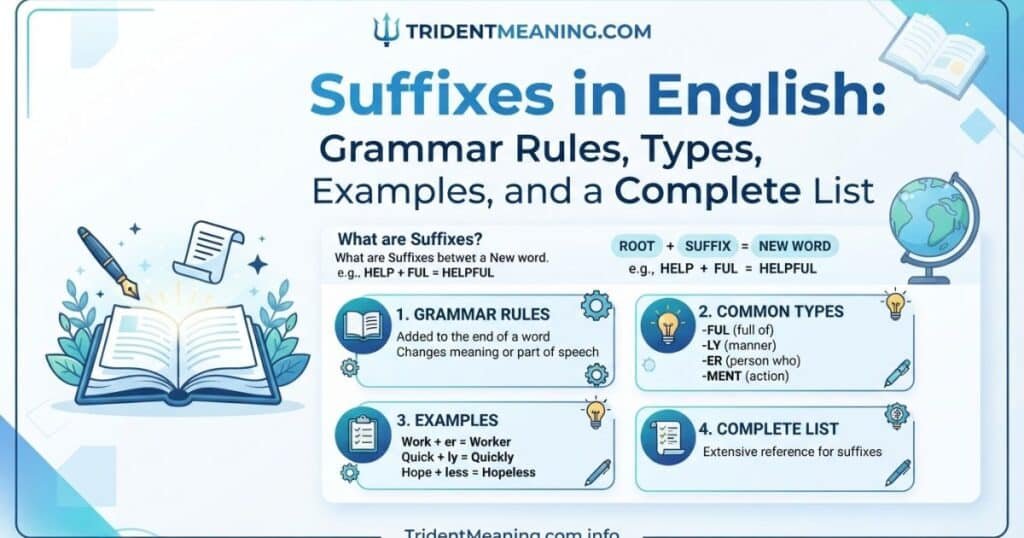

Ever wondered why one small ending can change a word? That’s where suffixes in English become useful. A suffix attaches to the end of a word and can change its meaning, form, or grammatical role. Once you understand the pattern, many unfamiliar words become easier to recognize.
Learning suffixes doesn’t have to feel like memorizing a grammar chart. Simple suffix examples can show how a base word develops into a new one. You’ll also see how a suffix word fits into everyday English. These patterns can make spelling, vocabulary, and word formation easier to understand.
In this guide, you’ll explore suffix examples in english, a practical suffix words list, and a noun suffixes list. You’ll learn what common endings mean, how they work, and how they change words. By the end, you’ll have a way to spot and use suffixes.
What Are Suffixes in English?

A suffix is a letter or group of letters added to the end of a base word. It can create a new word, change the word’s grammatical role, or add a specific meaning. For example, adding -ness to kind gives you kindness, while -ly changes quick into quickly.
In simple terms, suffixes are word endings that help build vocabulary. They can turn verbs into nouns, nouns into adjectives, or adjectives into adverbs. However, not every word ending should automatically be treated as a suffix. You need to look at how the ending functions within the word.
Suffix Meaning in English Grammar
In English grammar, a suffix is attached after a root, stem, or base word. The resulting word may belong to a different part of speech or may simply show a grammatical change.
For instance, teach becomes teacher with -er, while happy becomes happiness with -ness. Understanding this pattern can help you recognize unfamiliar vocabulary more easily.
How Suffixes Change Words
Suffixes can change both the form and function of a word. Some create a completely new lexical item, while others express grammatical information such as plurality, tense, or comparison.
Consider help, helpful, helpless, and helpfully. The base remains recognizable, but each ending adds something different. This is one reason suffixes are so useful when learning English vocabulary.
Types of Suffixes in English
English suffixes can be grouped in several ways. A useful distinction is between derivational and inflectional suffixes. Diminutive endings are another group learners often encounter, especially in informal vocabulary.
Knowing these types makes suffix patterns much easier to understand. Instead of memorizing every word separately, you can start noticing what each ending does.
Derivational Suffixes
Derivational suffixes help create new words. They can change the meaning of a base word or move it into another word class.
For example, teach becomes teacher, kind becomes kindness, and modern becomes modernize. The new words have their own meanings and may perform different grammatical jobs.
Inflectional Suffixes
Inflectional suffixes show grammatical information without normally creating a completely new dictionary word. Common examples include -s, -ed, -ing, -er, and -est.
For example, cat becomes cats to show plural number. Similarly, walk can become walked for past tense, while small can become smaller for comparison. These endings affect grammatical form rather than creating unrelated vocabulary.
Diminutive Suffixes
Diminutive suffixes can express small size, familiarity, affection, or informality. Common English examples include -let, -y, and some informal endings used in particular words.
Words such as booklet and piglet show how -let can suggest something smaller. These endings don’t always have a predictable meaning, so it’s best to learn common examples as vocabulary items.
Common Suffixes in English
Some suffixes appear frequently in everyday English. They can help you guess the likely role or meaning of unfamiliar words, although they’re not absolute rules.
For example, -ness often forms nouns, -ful often forms adjectives, and -ly commonly forms adverbs. English has many exceptions, so always consider the complete word and sentence.
Common Noun Suffixes
Noun suffixes often identify people, qualities, conditions, systems, or abstract ideas. Common examples include -er, -or, -ness, -ment, -tion, -ity, -ship, and -hood.
Examples include writer, actor, kindness, movement, education, ability, friendship, and childhood. These patterns can make new vocabulary easier to recognize.
Common Verb Suffixes
Several endings commonly help form verbs from other words. Examples include -ate, -en, -ify, and -ize/-ise.
You can see these patterns in words such as activate, soften, simplify, and organize. American English commonly uses -ize in words such as organize, while -ise is also found, especially in British English.
Common Adjective Suffixes
Adjective suffixes can help describe qualities, characteristics, materials, or relationships. Frequent endings include -able, -ful, -less, -ous, -ive, -al, -ic, -ish, and -y.
Examples include readable, helpful, careless, famous, active, natural, poetic, childish, and rainy. These endings often provide useful clues about a word’s grammatical role.
Common Adverb Suffixes
The ending -ly is the most familiar adverb suffix in English. It appears in words such as slowly, carefully, quietly, and easily.
Other endings also occur. Words ending in -ward or -wise can function as adverbs, as in upward, homeward, clockwise, and otherwise. Still, not every -ly word is an adverb; friendly and lovely, for example, are adjectives.
List of Suffixes in English With Meanings
A suffix words list is useful when you’re building vocabulary or studying English grammar. The meaning isn’t always identical in every word, but common patterns can provide helpful clues.
Here are some frequently used suffixes and their typical functions:
| Suffix | Common function | Example |
| -er | person who does something | teacher |
| -ness | quality or state | kindness |
| -ment | result or condition | enjoyment |
| -tion | action or process | creation |
| -ity | quality or condition | honesty |
| -ship | state or relationship | friendship |
| -ful | full of | helpful |
| -less | without | careless |
| -able | capable of being | washable |
| -ous | having a quality | dangerous |
| -ive | having a quality or function | creative |
| -ly | manner or frequency | quickly |
| -ize | make or become | modernize |
| -ify | make or cause | simplify |
| -en | make or become | strengthen |
Suffixes Used to Form Nouns
Many noun suffixes turn verbs or adjectives into nouns. For example, -er can identify a person who performs an action, while -ness often expresses a quality.
Examples include teach → teacher, drive → driver, kind → kindness, and dark → darkness. Other common noun endings include -ment, -tion, -ity, -ship, and -hood.
Suffixes Used to Form Verbs
Verb-forming suffixes can turn nouns or adjectives into actions or processes. Common examples include -ify, -ize, -en, and -ate.
For example, simple becomes simplify, modern becomes modernize, and short becomes shorten. These endings often carry the general idea of causing a change or making something become a certain way.
Suffixes Used to Form Adjectives
Adjective suffixes are useful for describing people, objects, qualities, and conditions. Common endings include -ful, -less, -able, -ous, -ive, -al, -ic, and -y.
For example, care → careful, hope → hopeful, hope → hopeless, comfort → comfortable, and cloud → cloudy. The resulting adjectives can then modify nouns in sentences.
Suffixes Used to Form Adverbs
The most familiar adverb-forming ending is -ly. It often changes an adjective into a word that describes how an action happens.
For example, careful → carefully and quiet → quietly. Other endings, including -ward(s) and -wise, appear in words such as backward and clockwise. These patterns are helpful, but context still matters.
Suffixes in English Examples
Seeing suffix examples in real words is one of the easiest ways to understand them. Start with the base word, identify the ending, and then ask what changed.
For example, dark becomes darkness, changing an adjective into a noun. Likewise, quick becomes quickly, changing an adjective into an adverb. These examples show how word formation works in practical English.
50 Examples of Suffixes in English
Here are 50 useful suffix examples:
- teach → teacher
- drive → driver
- act → actor
- kind → kindness
- happy → happiness
- dark → darkness
- develop → development
- enjoy → enjoyment
- govern → government
- create → creation
- educate → education
- equal → equality
- friend → friendship
- child → childhood
- leader → leadership
- care → careful
- hope → hopeful
- use → useful
- pain → painful
- help → helpful
- care → careless
- hope → hopeless
- home → homeless
- read → readable
- wash → washable
- comfort → comfortable
- danger → dangerous
- fame → famous
- nerve → nervous
- create → creative
- act → active
- nation → national
- music → musical
- child → childish
- rain → rainy
- cloud → cloudy
- quick → quickly
- quiet → quietly
- easy → easily
- careful → carefully
- soft → soften
- short → shorten
- simple → simplify
- beauty → beautify
- modern → modernize
- legal → legalize
- strength → strengthen
- broad → broaden
- small → smaller
- fast → fastest
These examples cover noun, verb, adjective, adverb, and grammatical suffix patterns.
Suffix Examples in Sentences
Suffixes become even clearer when you see them in context.
- Kindness can make a difficult day feel easier.
- The teacher explained the lesson clearly.
- We need a careful plan before starting.
- She answered the question quickly.
- They want to modernize the old building.
- The weather became colder after sunset.
Notice how the ending helps you understand the word’s role or meaning. Context gives you another clue when you’re unsure.
Suffixes in English Grammar
Suffixes play an important role in English grammar and word formation. Some help identify a likely part of speech, while others mark grammatical information.
However, suffixes aren’t perfect labels. English contains exceptions, borrowed words, and words that can belong to more than one grammatical category.
How Suffixes Affect Parts of Speech
A suffix can help change one part of speech into another. For example, -ness commonly turns adjectives into nouns, while -ly often turns adjectives into adverbs.
Consider this sequence: happy → happiness and slow → slowly. In the first example, the result is a noun. In the second, the result is commonly an adverb. These patterns can help you analyze unfamiliar words.
Inflectional Suffixes in English Grammar
Inflectional suffixes mainly show grammatical differences. Examples include plural -s, third-person singular -s, past-tense -ed, present participle -ing, comparative -er, and superlative -est.
For example, book → books shows number, while walk → walked shows past tense. Similarly, tall → taller → tallest expresses comparison. The base idea remains connected to the original word.
Rules for Adding Suffixes to Words
Adding a suffix sometimes requires a spelling change. One common pattern involves words ending in y. For example, happy becomes happiness, with y changing to i.
Other changes can involve dropping a final e or doubling a consonant. For instance, make → making and run → running. These rules depend on the suffix and the base word, so checking the complete spelling is important. Cambridge also notes that suffixation can trigger spelling changes in English.
Suffixes in English Words
Once you start looking for word endings, you’ll notice suffixes everywhere. They appear in everyday vocabulary, academic terms, professions, descriptions, and grammatical forms.
A suffix can sometimes give you a useful clue before you know the entire word. For example, a word ending in -ness is often a noun, while one ending in -able is often an adjective.
Common Words With Suffixes
Here are a few everyday words containing familiar suffixes:
- happiness — happy + -ness
- teacher — teach + -er
- helpful — help + -ful
- careless — care + -less
- quickly — quick + -ly
- national — nation + -al
- creative — create + -ive
- friendship — friend + -ship
These words show why learning suffix patterns can expand your vocabulary without memorizing every word from scratch.
Root Words and Their Suffixes
A root word carries the central meaning of a word, while a suffix can add information to it. In basic English study, you’ll often work with a base word and then identify what was added.
For example, teach is the base in teacher, and -er adds the idea of a person who teaches. In kindness, kind supplies the core idea, while -ness turns that quality into a noun.
Prefixes and Suffixes in English
Prefixes and suffixes are both types of affixes, but their positions are different. A prefix appears before a base or stem, while a suffix appears after it.
For example, unhappy has the prefix un-, while happiness has the suffix -ness. Learning both helps you understand how English builds and modifies words.
Difference Between Prefixes and Suffixes
The easiest way to remember the difference is position.
- Prefix: comes before the base word.
- Suffix: comes after the base word.
In rewrite, re- is a prefix. In writer, -er is a suffix. A single word can also contain both types, such as unhelpful, which has un- at the beginning and -ful at the end.
Prefixes and Suffixes With Examples
Compare these examples:
- happy → unhappy
- help → helpful
- agree → disagree
- care → careless
- write → rewrite
- teach → teacher
Prefixes often modify the meaning of a word, while suffixes frequently influence word formation or grammatical class. However, both can affect meaning.
Suffixes in English Exercises
Exercises can help you recognize suffix patterns instead of simply memorizing definitions. Try separating each word into its base and ending.
For example, in careless, identify care as the base and -less as the suffix. Then think about what the ending contributes to the meaning. This approach makes practice more useful.
Fill-in-the-Blank Suffix Exercises
Complete each word using an appropriate suffix:
- kind + ______ = kindness
- teach + ______ = teacher
- care + ______ = careful
- quick + ______ = quickly
- modern + ______ = modernize
- hope + ______ = hopeless
- develop + ______ = development
- soft + ______ = soften
Answers: -ness, -er, -ful, -ly, -ize, -less, -ment, -en.
Identify the Suffix in Each Word
Try identifying the suffix in each word:
- happiness
- readable
- friendship
- carefully
- dangerous
- teacher
- modernization
- childish
The answers are -ness, -able, -ship, -ly, -ous, -er, -ation, and -ish. Practice this skill regularly, and you’ll begin recognizing suffix patterns naturally.
How to Identify a Suffix in a Word
Finding a suffix starts with looking at the end of a word. But don’t simply assume that the final letters are always a suffix.
First, look for a recognizable base word. Then check whether removing the suspected ending leaves a meaningful form. Finally, consider whether the ending contributes a recognizable meaning or grammatical function.
Simple Steps to Find the Suffix
Use these four steps:
- Look at the word ending.
- Find a possible base or root word.
- Separate the ending from the base.
- Ask what the ending changes or adds.
For example, take carefully. You can identify careful as the adjective and -ly as the ending that forms the adverb. This method works well for many common suffix words.
How Suffixes Change Word Meaning and Form
Suffixes can add meanings such as a person, quality, absence, ability, process, or characteristic. They can also change a word’s grammatical category.
For example, hope becomes hopeful, meaning full of hope, while hopeless expresses the absence of hope. The base stays recognizable, but the suffix changes what the complete word communicates.
Examples of Word Formation With Suffixes
Here are several simple word-formation patterns:
- beauty → beautiful: adds a descriptive quality
- friend → friendship: expresses a relationship or state
- dark → darkness: turns a quality into a noun
- organize → organization: names an action, process, or result
- read → readable: expresses possibility or suitability
- child → childish: describes a characteristic
These examples show why suffixes are important in vocabulary development. Once you understand common endings, longer words often become easier to break down.
Suffixes in English PDF and Practice Resources
If you’re studying suffixes for school, grammar practice, or vocabulary building, a printable suffix list can be useful. You can organize endings by noun, verb, adjective, and adverb patterns.
A good practice sheet should include the suffix, its common function, several examples, and a few exercises. This gives you both the rule and enough context to remember it.
How to Practice Suffixes With a Word List
Start with a small suffix words list rather than trying to memorize hundreds of endings. Learn five or six common patterns first.
For each suffix, write several base words and create new words. Then use those words in short sentences. This combines spelling, vocabulary, grammar, and context in one exercise.
FAQs About Suffixes in English
What is a suffix in English grammar?
A suffix is a letter or group of letters added to a word’s end to create meaning, change form, or show grammatical information.
What are the most common suffixes in English?
Common suffixes include -s, -ed, -ing, -er, -ness, -ful, -less, -ly, -tion, -able, and -ous.
What are examples of suffixes in English?
Examples include -ness in happiness, -er in teacher, -ful in helpful, -less in careless, and -ly in quickly.
What is the difference between prefixes and suffixes?
A prefix comes before the base word, while a suffix comes afterward; both can modify meaning or create new words.
How do suffixes change word meaning?
Suffixes can add meanings related to qualities, people, absence, ability, processes, characteristics, or grammatical relationships within words.
What are inflectional suffixes in English?
Inflectional suffixes show grammatical information such as plurality, tense, participles, comparison, and third-person singular verb forms.
How can I learn suffixes in English easily?
Group common endings by function, study examples, practice identifying them, and create new words from familiar root words.
CONCLUSION
Understanding suffixes in english can make grammar and vocabulary much easier. These small word endings help you recognize meaning, form new words, and understand how language works. Once you learn common patterns, unfamiliar words often become less confusing. You can also use suffix examples to see how a base word changes into another form.
A useful suffix word may show a person, quality, action, condition, or grammatical change. Reviewing suffix examples in english gives you practical patterns to remember. You can keep a suffix words list nearby while studying, then test yourself with new words. This makes practice simple and useful.
For deeper practice, organize endings by function and review them regularly. A noun suffixes list can help you spot common noun patterns quickly. However, remember that English has exceptions, so always consider context. With steady practice, you’ll recognize suffixes more naturally and build stronger vocabulary.