

Have you ever written a word that sounds right but looks wrong? That happens often with sore and soar. These two words sound alike, yet they carry very different meanings. Understanding sore vs soar can save you from spelling mistakes and confusing sentences.
The word sore usually describes pain, irritation, or tenderness. For example, you might have a sore throat after talking all day. Meanwhile, soar relates to rising or flying high, like a bird moving through clouds. If you’re wondering how to spell sore, the answer depends on what you mean. Learning the difference makes writing easier.
This guide explains sore vs soar with simple meanings, pronunciation, examples, and comparisons. You’ll also learn what people mean by sore in the sky, why that phrase can cause confusion, and how to remember the correct word without second-guessing yourself whenever you write.
What Is the Difference Between Sore and Soar?

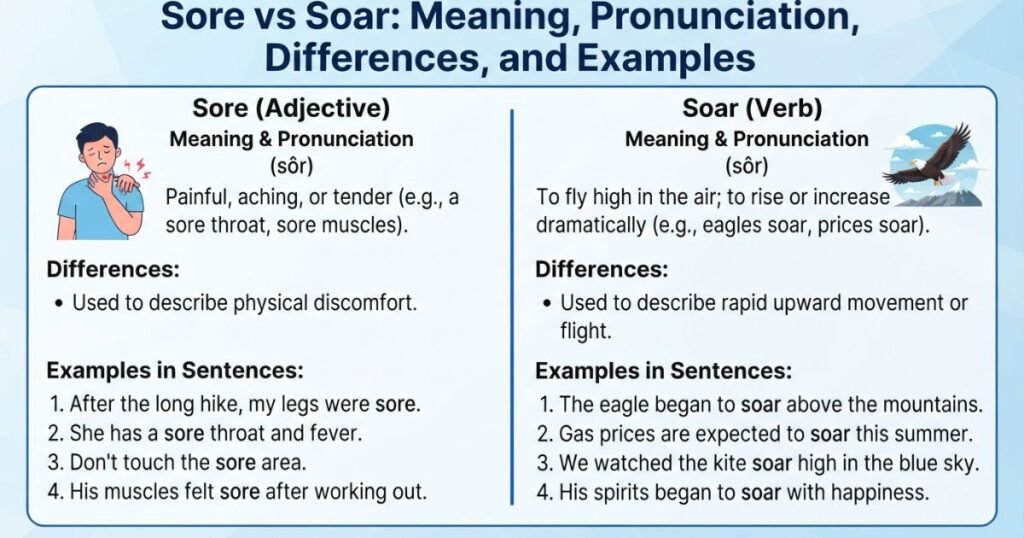
Sore and soar are homophones. That means they have the same pronunciation but different spellings and meanings. Sore generally refers to physical discomfort, tenderness, irritation, or sometimes emotional distress. Soar, on the other hand, means to rise high, fly upward, or increase quickly.
For example, you might say, “My legs are sore after the hike.” You could also say, “The hawk began to soar above the valley.” Looking at the surrounding words usually tells you which spelling makes sense.
Sore Meaning and Definition
Sore is commonly used as an adjective to describe something painful, tender, irritated, or uncomfortable. A person can have sore muscles, a sore back, or a sore throat. It can also describe someone who feels upset or resentful.
For example:
- My shoulders are sore after moving furniture.
- She has a sore throat today.
- He was still sore about losing the game.
The word can also appear as a noun in expressions such as a sore on the skin. So, its meaning depends slightly on how it appears in a sentence.
Soar Meaning and Definition
Soar is primarily a verb. It means to fly or rise high, often smoothly and without much visible effort. Birds such as eagles and hawks commonly soar on air currents.
The word can also describe something that rises rapidly in a figurative sense. For example, prices can soar, temperatures can soar, and someone’s confidence can soar after receiving good news.
Consider these examples:
- The eagle soared above the mountains.
- Her confidence soared after the successful presentation.
- Housing prices continued to soar.
Sore vs Soar at a Glance
A quick comparison makes the spelling difference easier to remember:
| Word | Main meaning | Example |
| Sore | Painful, tender, or irritated | My feet are sore. |
| Soar | Rise or fly high | The bird began to soar. |
Both words sound alike, but they don’t mean the same thing. Think about pain when you see sore and height or rising when you see soar.
Sore vs Soar Meaning and Usage
The main difference between these words comes down to what you’re describing. Sore usually connects with discomfort, tenderness, or emotional frustration. Soar connects with upward movement, flight, or a dramatic increase.
Context makes the choice much easier. If the sentence involves a body part, injury, or irritation, sore will often fit. If something moves upward or increases sharply, soar is usually the right choice.
When to Use Sore
Use sore when you want to describe pain, tenderness, irritation, or a feeling of being upset. It commonly appears before nouns such as throat, muscles, back, and feet.
For example:
- My arms are sore from lifting weights.
- He woke up with a sore neck.
- She felt sore after the long workout.
You can also use it in an emotional sense. Saying someone is sore about something means they’re annoyed, disappointed, or resentful.
When to Use Soar
Use soar when something rises high or moves upward. It’s especially common when discussing birds, aircraft, temperatures, prices, or emotions such as excitement and confidence.
For example:
- The plane soared above the clouds.
- The kite soared over the field.
- Food prices have soared recently.
The word doesn’t always involve physical flight. A person’s hopes or a company’s profits can also soar when they increase dramatically.
Sore vs Soar Synonyms
The synonyms for each word help show how different they are.
Sore can relate to words such as:
- painful
- tender
- aching
- irritated
- hurt
Soar can relate to:
- rise
- ascend
- fly
- climb
- increase
However, these words aren’t interchangeable in every sentence. A sore muscle can be painful, but it can’t soar. Likewise, a bird can soar, but it isn’t automatically sore.
Sore vs Soar Pronunciation
One reason this pair causes confusion is pronunciation. In standard American English, sore and soar are pronounced alike. The spelling is different, but the spoken sound is essentially the same.
That makes this a classic homophone pair. When you’re speaking, listeners rely on context. When you’re writing, you need to choose the correct spelling.
How to Pronounce Sore
Sore has one syllable, with the vowel sound commonly found in words such as more and four. The final e isn’t pronounced separately.
You don’t say each letter individually. Instead, the entire word is spoken as one smooth syllable. Hearing it in phrases like “sore muscles” or “sore throat” can make the pronunciation easier to recognize.
How to Pronounce Soar
Soar is also pronounced as one syllable. In common American pronunciation, it sounds the same as sore.
The spelling may look different because of the added a, but that doesn’t create an extra syllable. Context, rather than pronunciation, tells you which word someone means.
Why Sore and Soar Sound the Same
English contains many homophones, and sore and soar are a good example. Their spellings developed differently, but modern pronunciation brings them together.
This is why you may understand the intended word while listening but still hesitate when writing it. Paying attention to meaning is the best way to choose the correct spelling.
Sore vs Pain: What Is the Difference?
Sore and pain are related, but they’re not exact synonyms. Pain is a broad term for physical discomfort, while sore often describes an area that feels tender, irritated, or uncomfortable.
For instance, you might experience pain after an injury. Later, the injured area may remain sore while it heals. In everyday English, the two words can overlap, but their usage isn’t always identical.
What Does Sore Mean Compared With Pain?
Pain is usually a noun, although painful is the related adjective. Sore is commonly an adjective describing how something feels.
Compare these sentences:
- I have pain in my knee.
- My knee is sore.
- The injury caused severe pain.
- My knee feels sore after running.
The first examples focus more directly on the discomfort itself. The latter examples describe the condition or sensation of the affected area.
When to Use Sore Instead of Pain
Use sore when you’re describing tenderness or discomfort in a particular body part. It’s especially natural for mild discomfort caused by exercise, overuse, illness, or irritation.
For example, “My legs are sore after hiking” sounds natural. “My legs have pain after hiking” is understandable but less conversational.
If you’re talking about intense or medically significant discomfort, pain may be more appropriate. The exact choice depends on what you want to describe.
Sore vs Soar Examples in Sentences
Examples are one of the easiest ways to understand the difference. Notice how the surrounding words immediately reveal the intended meaning.
Sore examples:
- My back is sore after gardening.
- She has a sore throat.
- His feet became sore during the long walk.
- I was sore about the unfair decision.
Soar examples:
- The eagle soared across the open sky.
- The balloon began to soar upward.
- Her excitement soared when she heard the news.
- Fuel prices continued to soar.
The spelling changes because the meaning changes. You can use this simple context test whenever you’re unsure.
Examples Using Sore
Here are a few everyday examples of sore:
- My shoulders feel sore today.
- He developed a sore spot on his foot.
- Her throat was sore after the concert.
- I’m still sore from yesterday’s workout.
Notice that each example involves discomfort, tenderness, or an emotional reaction. That’s a useful clue when deciding whether sore is correct.
Examples Using Soar
Here are some natural examples with soar:
- The eagle soared over the forest.
- The plane soared above the clouds.
- Her confidence began to soar.
- Grocery prices continue to soar.
In these sentences, something rises, moves upward, or increases significantly. That meaning points to soar.
Sore and Soar in the Same Sentence
You can use both words in one sentence when their meanings are clearly different.
For example:
- After the hike left my legs sore, I watched an eagle soar overhead.
- My feet were sore while the hot-air balloon began to soar.
These examples make the distinction obvious. One word describes discomfort, while the other describes upward movement.
Is It Sore or Soar When Talking About Flying?
When you’re talking about flying or moving gracefully through the air, the correct word is soar. For example, “The eagle can soar for hours” describes the bird’s movement through the sky.
The phrase sore as in flying is therefore based on a spelling confusion. Even though sore sounds identical when spoken, it doesn’t mean to fly or rise through the air.
Why Soar Is Used for Flying
Soar describes upward or high movement, particularly when something flies smoothly. Birds are common subjects, but aircraft, gliders, and other objects can also soar.
You might say:
- The hawk soared above the canyon.
- The glider soared over the hills.
- The aircraft soared into the clear sky.
The key idea is elevation or upward movement.
Is Sore Ever Used to Describe Flying?
No, sore isn’t the standard word for flying. If you’re describing a bird or aircraft moving high through the air, use soar.
A simple memory trick helps: soar contains an a, which can remind you of air. It’s not a spelling rule, but it’s an easy association to remember.
Sore, Soar, and Saw: How Are They Different?
Adding saw to the comparison can make things slightly more confusing. Saw has a different meaning and pronunciation from sore and soar in most standard American English.
Saw is commonly the past tense of see. It can also refer to a cutting tool. So, the sentence around it usually makes its meaning obvious.
Saw Meaning and Usage
When saw is the past tense of see, it means that someone noticed or viewed something in the past.
For example:
- I saw a bird near the window.
- She saw the movie last night.
- We saw the plane above the trees.
As a noun, a saw is a tool used for cutting wood or other materials.
Sore vs Soar vs Saw in Sentences
Compare these examples:
- Sore: My legs are sore after running.
- Soar: The eagle can soar above the valley.
- Saw: I saw an eagle near the river.
The three words look and sound different in useful ways. Remembering their meanings is more reliable than trying to memorize spelling alone.
Common Mistakes With Sore and Soar
A common mistake is using sore when you mean something is flying or rising. Another is choosing soar when describing physical discomfort.
For example, “The bird began to sore” is incorrect when you mean that it flew upward. Likewise, “My arms are soar” is incorrect when you mean they hurt.
How to Remember Sore vs Soar Easily
Try connecting each spelling to its meaning:
- Sore = pain, tenderness, or irritation
- Soar = rise, fly, or increase
You can also remember a simple visual association: soar is connected with the air, while sore is connected with something that hurts.
If you’re writing and the word sounds right but you’re unsure about the spelling, stop and ask what the sentence means. That quick check usually solves the problem.
Sore vs Soar in Everyday English
You’ll encounter sore much more often when talking about your body, health, exercise, or feelings. Common phrases include sore muscles, sore throat, and sore feet.
Soar appears more often in descriptions involving flight, growth, or rapid increases. You might hear about birds soaring, temperatures soaring, or costs soaring.
Common Phrases That Use Sore or Soar
Some common expressions include:
With sore:
- sore muscles
- sore throat
- sore feet
- sore back
- sore spot
- sore about something
With soar:
- soar through the sky
- soar above the clouds
- soaring temperatures
- soaring prices
- soaring confidence
- soar to new heights
Learning these common combinations can make the correct spelling feel much more natural.
How to Choose Between Sore and Soar
When you’re deciding between these words, don’t focus only on how they sound. Ask what the sentence is actually describing.
If the idea involves pain, tenderness, irritation, or feeling upset, choose sore. If it involves flying, rising, climbing, or increasing sharply, choose soar.
A Quick Trick to Use the Correct Word
Use this quick mental test:
Does it hurt? → Sore.
Does it rise or fly? → Soar.
For example, “My knees are sore” describes discomfort. “The bird will soar” describes flight. Once you connect each spelling to its core meaning, sore vs soar becomes much easier to handle in everyday writing.
FAQs
What is the main difference between sore and soar?
Sore describes pain, tenderness, or irritation, while soar means to rise, fly high, or increase rapidly.
Are sore and soar pronounced the same?
Yes, sore and soar are homophones in standard American English, meaning they share pronunciation but have different meanings.
Is soar the word used for flying?
Yes, soar is used for flying or rising smoothly through the air, especially when describing birds, aircraft, or gliders.
Does sore mean pain?
Sore usually describes something painful, tender, or irritated, while pain is the broader term for physical discomfort.
What is an easy way to remember sore vs soar?
Remember sore for discomfort and soar for rising or flying. This simple meaning-based trick helps you choose the spelling.
Can sore and soar appear in one sentence?
Yes, you can use both when discussing discomfort and flight, such as sore feet while watching a bird soar.
Is sore or soar used for prices increasing?
Use soar when prices rise quickly or significantly. For example, you can say that grocery prices have soared.
CONCLUSION
Understanding sore vs soar becomes much easier when you remember their different meanings. “Sore” usually describes physical pain, tenderness, or something that feels irritated. “Soar,” on the other hand, relates to rising high, moving upward, or feeling extremely happy. Knowing this difference can help you avoid common spelling and grammar mistakes in everyday writing.
If you ever wonder how to spell sore, remember that it has no “a.” When someone asks about sore in the sky, they may actually mean “soar,” which describes something flying or rising through the air. Context is the easiest way to tell which word fits. A quick check can also prevent confusing sentences.
Overall, sore vs soar is a simple word distinction once you connect each spelling with its meaning. Use “sore” for pain or tenderness, and “soar” for rising or flying high. Keep that small difference in mind, and you’ll feel more confident choosing the correct word.